Toronto PPF can save your paint from serious damage. The right protection choice gets confusing though.
Road salt eats away at your vehicle’s finish. Rock chips from highway driving leave permanent marks. Toronto’s four-season climate attacks your car year-round. PPF cost in Toronto ranges from $700 for partial coverage up to $9,500+ for full-body wraps. You want to get this decision right.

This article breaks down everything about PPF in Toronto: coverage options, top brands like XPEL and how to pick a quality installer who won’t waste your money.
What Is Paint Protection Film (PPF)
Paint protection film is a transparent polyurethane film that creates a barrier between your vehicle’s paint and everything trying to damage it. You might hear it called clear bra or clear film, but they’re all referring to the same thing: a thermoplastic urethane material applied to your car’s painted surfaces.
Car manufacturers approve PPF for use on their vehicles. Porsche even installs it at the factory on certain models, on the rear arches. That factory seal of approval tells you something about how this technology performs.
How PPF Works
PPF absorbs and disperses the energy from impacts before they reach your paint. A rock hits your hood at highway speed, and the film takes the hit instead of your clear coat.
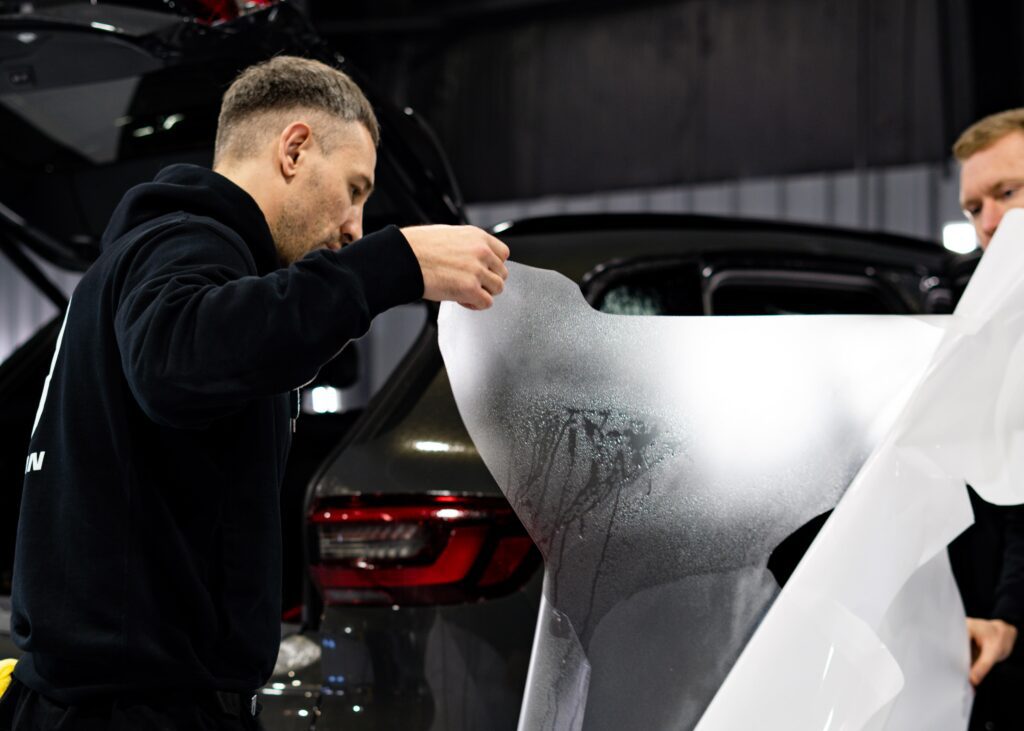
The material itself is quite flexible and ranges from 6 to 8 mils thick. This flexibility allows the film to stretch over complex curves and body lines without cracking or tearing. Professionals use slip solutions or gels as barriers to prevent premature adhesion during installation. Installers apply steam, heat guns and careful pre-stretching techniques to mold the film perfectly for tricky areas with sharp curves.
The film blocks UV radiation and resists chemicals like bird droppings, tree sap and bug acids. High-quality PPF won’t yellow or degrade over time when exposed to sunlight. Some newer products even include hydrophobic properties that repel water and contaminants, like what you’d get from ceramic coatings.
PPF Composition and Layers
Modern Toronto PPF uses multi-layer construction where each layer serves a specific function. Professional installers prefer this stratified design over single-layer films because the specialized layers work together to absorb impacts and extend longevity.
The topcoat sits on the surface at 1 to 2 mils thick. This layer is hydrophobic and self-healing. It repels water to prevent water spots and provides UV protection to maintain your paint’s vibrancy underneath. The glossy finish enhances the color depth of your vehicle’s paint.
Beneath that lies the thermoplastic polyurethane (TPU) core, which measures 6 to 8 mils thick. This middle layer does the heavy lifting. It absorbs impacts from rocks and debris, with high elongation capabilities up to 300%. Think of it as a cushion that absorbs nearly 70% of impact energy and prevents chips from reaching your paint job.
The bottom adhesive layer uses clear acrylic or silicone hybrid formulas. This pressure-sensitive adhesive bonds securely to your car’s paint without leaving residue. You eventually remove the film years later, and your paint stays intact and undamaged.
Quality matters a lot across these layers. Films age differently depending on construction quality. Some turn yellow over time while others stay crystal clear for a decade or more. Premium options from brands available for Toronto car PPF installations can maintain protective qualities even after 500 hours of UV exposure and multiple freeze-thaw cycles.
Self-Healing Properties Explained
Self-healing technology separates modern PPF from older protection methods. The topcoat contains specialized elastomers, which are polymers with molecular memory. Minor scratches occur, and these molecules temporarily deform but don’t break.
Heat triggers the healing process. Sunlight warming your vehicle, residual engine heat or even warm water poured over the scratched area activates the thermoplastic urethanes. These urethanes soften at temperatures between 40-60°C. The molecules flow back into their original shape through capillary action once activated and erase the scratch.
You don’t need special tools or expensive detailing visits. Park your car in sunlight on a warm day, and light scratches can disappear within minutes. Apply warm water or use a heat gun for deeper marks. The polymers reorganize themselves and fill in the damaged areas.
This self-healing capability maintains clarity for over ten years. The film continues to protect while looking flawless, which directly affects your vehicle’s resale value down the road.
Why Toronto Drivers Need PPF
Driving in Toronto subjects your vehicle to a perfect storm of paint-damaging conditions. The city’s position means harsh winters, busy highways and environmental exposure that compounds over time.
Winter Road Salt and Corrosion
Road salt accelerates rust and corrosion on exposed metal surfaces. Toronto winters bring repeated applications of sodium chloride and chemical deicing agents that don’t just stay on the pavement. Salt splashes upward as you drive and settles on wheel wells, undercarriage components, lower panels and trim. This residue becomes highly corrosive when moisture gets added.
Salt crystals that settle on your car draw moisture from the air and maintain corrosive conditions. This creates ongoing damage cycles throughout winter months. The repeated freeze-thaw cycles common in winter weather compound chemical damage with the physical stress of changing temperature.
Electric vehicles face unique risks because battery packs, cooling lines and electronics sit low in the chassis and are more sensitive to corrosion. High-voltage connectors, charging ports and aluminum battery housings can degrade faster than similar components on gas-powered vehicles.
Salt brine makes matters worse. This mixture of water and salt seeps into smaller areas, cracks, crevices or chips in your vehicle’s paint. Salt can lift and separate layers once it gets under the paint. This causes bubbling, flaking or peeling, especially in areas prone to stone chips.
Highway Driving and Rock Chips
Rock chips occur at any speed, whether you’re cruising on the 401 at 70 mph or navigating city streets at 30 mph. Rocks, gravel and other road debris cause these small dings. They act like sandpaper against your vehicle’s exterior.
Conditions such as loose gravel, construction debris or poor road surfaces substantially heighten the chances of your vehicle getting chipped. The risk increases when you follow too closely behind another vehicle, especially when you have large trucks or construction equipment.
Highway driving subjects cars to a barrage of flying debris. Loose gravel, kicked-up rocks and road salt cause microscopic chips in the front bumper and hood. These physical impacts create small craters in the clear coat that invite rust and corrosion. What starts as a small chip can eventually become a much larger and more expensive repair. Temperature changes cause the metal to expand and contract, which can make small chips grow larger over time.
Certain areas face higher vulnerability. Front bumpers and hoods take the most direct hits from road debris. Side mirrors catch stones from passing vehicles while lower door panels accumulate chips from road spray. Wheel wells endure constant bombardment.
Year-Round Environmental Threats
Modern vehicles encounter over 40,000 different airborne contaminants annually. This creates a hostile environment for unprotected paint surfaces. Research shows that unprotected vehicles lose up to 50% of their gloss within two years due to environmental contamination alone.
UV radiation is the dominant long-term degradation mechanism for automotive paint. Bird droppings contain highly acidic and enzymatic compounds. Industrial fallout has hot metal particles that embed into paint. Acid rain leaves sulfuric and nitric acid residues. Tree sap deposits sticky organic acids and resins.
The invisible nature of most environmental contaminants gives vehicle owners a false sense of security. Molecular-level contamination begins right away upon exposure. Pollutants form chemical bonds that become harder to remove over time. The cumulative effect of multiple contaminant types creates accelerated damage patterns that overwhelm unprotected paint.
Protecting Vehicle Resale Value
PPF can affect your vehicle’s resale value by preserving the paintwork and protecting it from scratches, stone chips and other minor abrasions. Potential buyers see the presence of PPF as a sign that the vehicle has been well-maintained.
A national survey of U.S. automotive dealership professionals reveals compelling data. 96% of respondents believe applying PPF to all a vehicle’s painted surfaces helps retain more of its value over the original ownership period. 70% cite value-retention gains of up to 15%. More than 90% of respondents say that PPF applied to a vehicle should give owners greater confidence in the resale value when it’s time to trade in or sell.
Vehicles with PPF experience slower devaluation rates compared to their unprotected counterparts. The preserved cosmetic condition maintains allure over time. This delays the visual effects of age-related wear and tear. Dealership decision-makers overwhelmingly agree. 92% say vehicles with PPF applied to all exterior surfaces when new would have a higher resale value as preowned inventory.
Vehicles in exceptional condition qualify for lucrative certified pre-owned programs, which just need cars to meet rigorous cosmetic standards.
PPF Coverage Options in Toronto
The coverage level you pick decides how much protection your vehicle gets and what you’ll spend. Toronto car PPF comes in four main configurations. Each targets different driving patterns and budgets.
Partial Front Coverage
Partial front coverage targets high-impact zones without wrapping the entire front end. This package has the front bumper, partial hood (18 to 24 inches from the leading edge), partial front fenders, headlights, and mirror caps.
The partial hood strip intercepts most stone chips that land on the front edge. Front fenders absorb side-impact debris from passing vehicles. Vehicles driven mostly in city traffic with limited highway exposure get much of the rock chip risk intercepted at the lowest cost of entry.
The limitation is both practical and cosmetic. The film ends partway across the hood and creates a visible edge line. Multiple owners report that this line bothers them over time, especially on dark paint. Many end up upgrading to full front within a year or two. Partial coverage costs between $1,100 and $2,000.
Full Front End Protection
Full front PPF delivers seamless protection across every surface forward of the A-pillars. Coverage has the full hood, full front bumper, full fenders, mirror caps, and headlights.
This option addresses about 80% of rock chip damage locations. So it’s the most popular PPF package in the industry and accounts for around 60% of all installs. Chips and sandblasting hit the bumper, hood, fenders, and headlights at the same time at highway speeds. Partial protection leaves fenders and headlights exposed. Uncovered paint sits right next to protected paint and ages differently over time.
Headlights alone cost $800 to $2,500 per assembly to replace on most modern vehicles. PPF prevents the hazing, pitting, and yellowing that make older headlights look worn. This package works for daily highway commuters and anyone putting 15,000 or more miles per year on their vehicle. Owners who want the best protection-to-cost ratio benefit most. Toronto PPF wrap pricing for full front ranges from $1,500 to $4,000 depending on the vehicle and film brand.
Full Body PPF Wrap
Full body coverage wraps every painted surface with no exceptions. This has everything in the full front package plus all doors, rear fenders and quarter panels, roof, trunk lid, rear bumper, A-pillars, and rocker panels. No painted surface remains exposed.
Installation takes three to five days because of the prep work, panel count, and curing time required. Full body installations cost $5,000 to $8,000 for clear film. This investment makes sense for luxury and exotic vehicle owners. Anyone keeping the vehicle for five to ten or more years benefits. Leased vehicles where end-of-term paint charges are a concern also fit this category.
Custom High-Impact Areas
The track pack sits between full front and full body coverage. This configuration has everything in the full front package plus rocker panels, A-pillars, door edges, door cups, and the rear bumper loading area. Some shops also add the leading edge of the roof.
Rocker panels take spray from your own tires. Door edges absorb impact when a door swings open in tight spaces. A-pillars catch gravel at speed from the side. This tier suits owners who want more than front protection but don’t need every panel covered. It’s especially useful when you have vehicles that see gravel roads, tight parking lots, or occasional track days.
Top PPF Brands Available in Toronto
Three brands dominate the Toronto car PPF market. Each brings different strengths to the table. Your choice between them comes down to what you value most: brand recognition, technical performance, or budget flexibility.
XPEL PPF Toronto
XPEL built its reputation on one killer advantage: the DAP (Design Access Program) software holds pre-cut patterns for over 99% of vehicles on the road. This database eliminates guesswork during installation. XPEL often provides the only precise template available for rare or unusual vehicles.
The film itself delivers excellent performance. XPEL Ultimate Plus runs 8.0 mil thick with self-healing that activates in seconds when you apply heat. Optical clarity ranks at the top and makes the film invisible on your paint. The company supplies the U.S. military, which speaks to durability standards.
But XPEL costs 15-25% more than comparable films. You’re paying in part for the film and in part for brand recognition. The extensive certified installer network makes warranty claims straightforward. The warranty transfers to the next owner. That transferable coverage adds legitimate value at resale.
3M and SunTek Options
3M invented paint protection film for military helicopter blades before adapting it for cars. The Scotchgard Pro Series represents their current flagship product and comes in two tiers. The G100 Series focuses on economical protection for standard installations. The G200 Series adds hydrophobic surfaces and matte finish options with extended warranty coverage.
3M films run thinner at 4.0 mil. This makes them easier to install on curves and complex body lines. Manufacturing consistency stays excellent across batches. Self-healing works but happens slower than XPEL. White or silver vehicles show no visible difference between 3M and XPEL. Black or dark metallic finishes reveal XPEL’s optical clarity edges ahead.
SunTek delivers strong performance at lower cost. The Ultra line measures 5.5 mil thick and sits between XPEL and 3M. The Reaction formula focuses on faster self-healing. SunTek costs 15-20% less than XPEL, which makes it the value choice for daily drivers where maximum coverage matters more than brand prestige.
Premium vs Economy Film Grades
Testing lab evaluations of 15 different PPF grades over three years show most important performance variations between quality levels. Premium films cost 40% more than standard options, but protection differences justify this increase.
Budget films show problems after 12-18 months: yellowing on light-colored vehicles, edge lifting, reduced self-healing, and permanent staining. Quality films maintain protective qualities even after 500 hours of UV exposure and multiple freeze-thaw cycles.
Warranty Differences Between Brands
All three major brands now offer 10-year manufacturer warranties on premium products. XPEL Ultimate Plus, 3M Scotchgard Pro, and SunTek Ultra all carry decade-long coverage against yellowing, cracking, and peeling.
The real differences lie in transferability and labor coverage. XPEL and 3M warranties both transfer to second owners. SunTek warranties also transfer. 3M includes labor reimbursement on select claims, which other brands don’t cover.
Toronto PPF Cost Breakdown
Understanding Toronto PPF cost starts with one reality: installations range from $300 to over $9,000 depending on what you’re protecting and how you’re protecting it.
Factors That Affect PPF Pricing
Several variables meet to determine your final price. Coverage level represents the main driver because more panels mean more material and labor. Film quality follows close behind, where premium self-healing films cost $7 to $12 per square foot compared to standard films at $2 to $5 per square foot.
Installer expertise adds 15% to 30% to base pricing. Certified technicians charge more because they deliver edge wrapping precision and warranty support that budget installers skip. Your vehicle’s design complexity matters too. Sharp curves, sensors, and aerodynamic elements extend installation time. Luxury vehicles command premium pricing due to higher precision standards, with installations starting at $3,000 and climbing past $8,000 for full coverage.
Paint condition changes prep requirements before film touches your vehicle. Swirls, oxidation, or dirt require surface treatments that add $450 to $800 or more to your bill. Newer vehicles with pristine paint cost less to prepare than older ones needing paint correction.
Cost by Coverage Level
Partial front packages protect high-impact zones for $1,200 to $3,000. Full front coverage extends protection across the hood, bumpers, fenders, and mirrors, running $1,500 to $3,500. Track packages add rocker panels and A-pillars, pushing costs to $2,400 to $3,200. Full-body wraps covering every painted surface range from $5,000 to $8,000 or higher.
Individual panels offer targeted protection. Hood coverage runs $400 to $1,000, front bumpers cost $350 to $800, and fender pairs range from $300 to $800.
Vehicle Size Impact on Price
Larger vehicles need more film and labor, adding 20% to 40% to baseline costs. A compact sedan requires substantially less material than a full-size SUV or truck covering the same panels. Midsize SUVs run 20% to 30% higher than sedans, while large trucks and luxury SUVs climb 30% to 40% above compact car pricing.
Film Quality and Installation Labor
Premium films cost more upfront but deliver stronger UV resistance, self-healing topcoats, and 7 to 12 year warranties. Labor pricing ties to material costs since square footage reflects installation time. Complex body lines eat up 30 to 90 additional minutes per challenging curve.
How to Choose a Quality PPF Installer
The same premium film can look flawless on one vehicle and bubble, peel, or lift on another. The difference sits with who installs it.
Certifications and Training to Look For
Experience with PPF specifically matters more than general detailing work. Look for installers with at least 3-5 years of specialized PPF experience. A shop that’s been tinting windows for twenty years isn’t qualified to install paint protection film.
Manufacturer certifications verify that installers completed structured training programs. These programs cover surface preparation, film cutting, application techniques and edge sealing. XPEL, SunTek, 3M, and STEK all offer certification programs. You can verify these certifications on manufacturer websites.
IDA (International Detailing Association) certification represents proven technical expertise and commitment to industry best practices. Ask installers how many vehicles they’ve completed and whether they’ve handled your specific make and model. Seasoned professionals have worked on hundreds or thousands of vehicles.
Installation Environment Requirements
Clean rooms minimize dust and debris that cause permanent imperfections under the film. Professional studios maintain particle counts at less than 1,000 particles per cubic meter. PPF applied in clean rooms maintains 95% of its original adhesion strength after six months. Installations in uncontrolled conditions drop to just 80%.
Temperature control between 20°C and 30°C allows film to stretch and conform. The film won’t stretch if it’s too cold. It tacks before positioning if it’s too hot. HEPA filters capture environmental particulates like pollen and airborne bacteria that infiltrate workspaces and cause peeling or bubbling.
The installation bay should be enclosed and separated from dusty operations like sanding or painting. Visit the facility before booking. A clean space with bright lighting represents the minimum standard for quality work.
Questions to Ask Before Booking
Ask which specific PPF brands they carry and why they chose them. Quality shops name recognized brands like XPEL Ultimate Plus or SunTek Ultra, not vague answers like “proprietary film”. Request their PPF-specific portfolio that shows actual installations on vehicles like yours, not manufacturer stock photos.
Ask about their installation process: surface preparation steps, whether they use computer-cut patterns or hand-cut on the vehicle, how they handle edges (wrapped vs trimmed), and curing time requirements. Ask about warranty coverage. You need to distinguish between the shop’s installation warranty (typically 2-5 years) and the manufacturer’s product warranty.
Request references from clients with vehicles like yours. Verified reviews on Google or industry platforms that mention long-term satisfaction carry more weight than results you see right away.
Red Flags to Avoid
Walk away if you see visible film edges sitting on panel faces rather than wrapped around edges. Dust specks or bubbles under the film indicate uncontrolled environments. Run your fingernail along panel edges to check for cut marks in the clear coat from freehand blade work.
Overstretched film shows warped, lens-like effects around curves and will fail early at stress points. Same-day turnaround promises for full front or full body installations mean corners are being cut somewhere. Shops that won’t show you their installation area are hiding something.
PPF vs Other Protection Options
Protection confusion happens because three different products get recommended for similar goals, yet they work in different ways.
PPF vs Ceramic Coating
PPF stops physical damage before it reaches your paint. Ceramic coating stops environmental and chemical damage from degrading the paint surface over time. One protects against what hits your paint. The other protects against what lands on it and stays there.
PPF absorbs rock chips, scratches, and impacts from road debris. Ceramic coating repels water, contaminants, UV radiation, and oxidation. PPF maintains your original paint appearance without adding visual improvement. Ceramic coating improves paint gloss, deepens color, and delivers a showroom-quality shine.
Ceramic coating costs a fraction of PPF pricing. Full front PPF can run several thousand dollars, while ceramic coating offers excellent protection at lower cost. Maintenance differs too. The hydrophobic properties of ceramic coating make washing simpler and less frequent. PPF requires more attention to prevent contaminant buildup.
Ceramic coatings can last up to 9 years with professional application. PPF lasts 5 to 10 years depending on quality and environmental exposure.
PPF vs Vinyl Wrap
Material composition separates these two products. PPF uses thermoplastic polyurethane. Vinyl wrap uses polyvinyl chloride. PPF measures between 6 and 10 millimeters thick. Vinyl wrap runs just 2 to 4 mils.
PPF exists to protect. Vinyl wrap exists to transform appearance. The average lifespan for PPF reaches about 10 years. Vinyl wraps usually last about half that time, roughly 5 years.
Combining PPF with Ceramic Coating
Applying ceramic coating on top of PPF extends overall durability for both products. The combination delivers unmatched protection. Apply PPF to high-impact areas first, then ceramic coating over the entire vehicle including the PPF. This creates layered defense where PPF handles rock chips while ceramic coating adds UV protection and easy cleaning. Ceramic coating services like ID Protection’s PPF installation help Toronto drivers apply this combined approach for maximum paint preservation.
Making Your PPF Decision
Your decision starts with honest self-assessment. Document your actual driving patterns over several weeks: frequency, route types, parking situations, and unusual exposures. This real-life data shows your true exposure profile. Compare your usage against coverage options to identify which package addresses primary threats without extending to rarely-exposed areas.
Assessing Your Protection Needs
Debris from your own tires often causes more damage than cars ahead of you. Rocker panels, lower door sections, and rear bumpers behind rear tires are major targets. High-impact areas need wrapping for improved protection based on your vehicle’s shapes and angles. Conservative starts work well since you can add extended coverage later if usage patterns change.
Budget Considerations
Right-sized protection delivers value without unnecessary expense. Complete coverage costs more but protects more paint from expensive repair. Expand your coverage if repainting a single panel costs more than adding it to your PPF package. The economic analysis should look at potential repair costs for unprotected areas.
Timeline for Installation
Partial front installs take 4 to 8 hours. Full body installs take 1 to 3 days.
Getting Accurate Quotes
Request personalized quotes based on your specific vehicle, desired coverage, and installation goals. Professional assessment looks at factors you might overlook and recognizes vehicle-specific vulnerabilities.
Conclusion
You now have the complete roadmap to protect your vehicle’s paint in Toronto’s challenging climate. Road salt and environmental damage won’t wait, so your protection shouldn’t either.
Assess your actual driving patterns and budget first. Match your coverage level to real-life exposure rather than stretching for unnecessary protection. Quality installation matters just as much as premium film, so don’t cut corners on either.
Get quotes from certified installers who work in controlled environments and use recognized brands. Toronto PPF installation studio ID Protection delivers that combination. Your paint takes years of abuse without PPF. Give it the protection it deserves, and your vehicle will maintain its value for years to come.